Tuesday, October 26, 2010

Light Artist - James Turrell


Light is an illuminating agent or source, as the sun, a lamp, or a beacon (dictionary.com).


James Turrell


James Turrell is a light artist who works with light and space and the way that light can enter a space to portray a meaning without words that can still stimulate the senses. Turrell works with the light to give the people viewing it a pure lighting experience.  He has spent years working with light and exploring light as an intellectual idea and by using it as a physical material in his work.  He is fascinated by spaces and the perceptual illusions light can cause. I think that how he creates these light effects was very intriguing and my favorite piece from his body of work is his Dividing the Light exhibit.


Dividing the Light


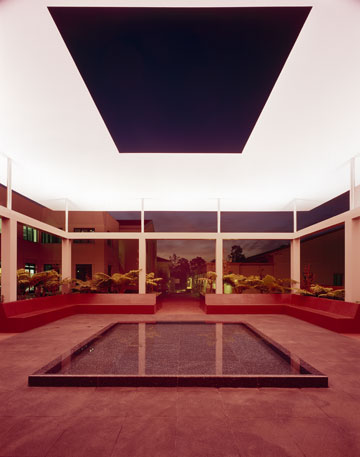
This one is called Dividing the Light, which is another one of James Turrell’s works, which is on permanent exhibit at the Pomona College Museum of Art.  This exhibit shows how Turrell uses architecture to play with rays of light to create his own light phenomenon.  I thought it was interesting how he used to the marble slab placed directly below the opening in the ceiling to reflect the light coming in from the skylight and create a mirror effect of the space around the smooth slab.
Dividing the Light

Dividing the Light

End Around
In this work James Turrell uses two different kinds of light sources, neon lights and florescent lights, in the space.  The fluorescent lights are placed outside of the tunnel to create a luminous color throughout the area.  Then the strips of blue neon lights are placed behind glass framing the doorway at the end of the tunnel.  The combination of these two lights create a lighting effect all their own because when you mix two different types of light it messes with your eyes in strange ways.  This piece has a atmosphere to it that will have the view transfixed.

End Around

Entrance to End Around


Tadao Ando’s work is somewhat similar to that of James Turrell’s in the way that he too finds artistic ways to have light enter into a space to create a unique light phenomenon.


For more work from James Turrell and my source of information for this page click here.


Monday, October 18, 2010

The chair, the stool, and the magazine holder

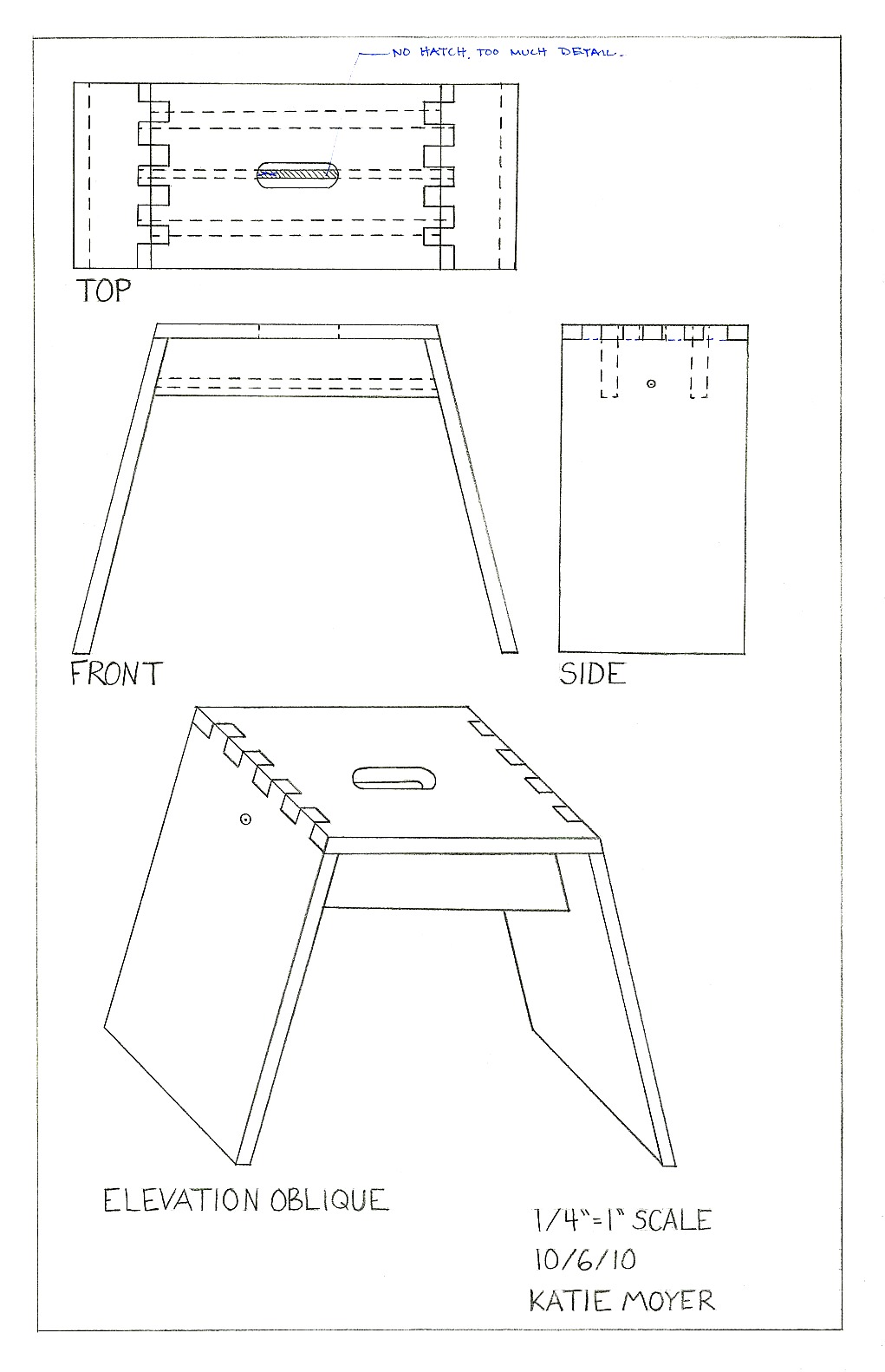
For the stool I think the overall drawing is good.  However, I think I could have better laid it out so that I could fit the orthographic drawings and the pictorial drawing all on the page in a horizontal layout instead of vertical.

For the magazine holder I need to improve on line quality and line weight because I need to remember in the future to make my hidden lines lighter than the object lines.  For this object I also forgot to add in the hidden lines that were suppose to show material thickness in the orthographic views.

 
For the chair I still need to improve my line quality and remember to make my hidden lines a lighter value than my object lines.

Extra Credit Assignment


For my extra credit assignment I think I did all of the components of the assignment well but I think I still need to improve my line weight.

Wednesday, October 13, 2010

Drafting Assignment: Choice Object

 
For my object pictorial assignment I think everything turned out well other than the circles and the charge connector.  The place where the charger plugs into the iPod is not centered on the object in my plan view or my elevation oblique view.  Also the small middle ellipses on both the isometric view and the elevation oblique view do not look the way that they were suppose to.

Drafting Assignment: Object A & Object B

  
Plan Oblique View

For my pictorial views of Object A and Object B all of them turned out well. However, on my plan oblique view the lines in the back of the cut out section are not parallel to the other lines at that angle like they are suppose to be.

Elevation Oblique View

 Isometric View


Monday, October 4, 2010

Seeing the light: Light Phenomenon Project

 I got my idea from inside the courtyard at the Ferguson building.  There is a square hole cut in the covered part of the courtyard and the sun was shinning through it and illumination part of the tree below it.  I thought it was interesting how the square illuminated a square double its size onto the tree and turned the leaves a very bright shade of green whereas everything else that was in the shadow looked almost black.

For my diagrammatic model to demonstrate my light phenomenon I used florist wire to represent the light rays and used green translucent paper to represent the leaves.  So I pierced the wire through the leaves to signify the light passing through the leaves to create my light phenomenon. Then for my diagrammatic sketch I used a similar idea but used arrows to represent the rays of light.  I also added in two different images of my light phenomenon.  One of the photos is in black and white while the other is in color.

Sunday, October 3, 2010

A place for twelve twigs

For my place for twelve twigs my inspiration for their place was the layers of bark on the twigs. When I first got my twigs I carved the bark off of one of my twigs and realized there were three layers. 

For my first model I started out by using hemp threaded through the paper to hold the twigs into the paper and then connect the transparent duct tape over where the hemp went through.  The duct tape was an interesting element because it resembled the appearance of the bark on the original stick.  

Then for my second model I made a sketch model with four twigs.  I changed the from from what it was in the first model to a cylindrical form with a spiral of duct tape wrapping around the entire cylinder.  

However, even though it worked in the second model when I tried to make a bigger version of it for my third model it did not go nearly as well.  Instead of one piece of duct tape I used two and crossed them on each other to make a double helix form. However, in the end none of these forms worked very well without looking sloppy other then my very first model.

For my final model I went back to the original form that I used in the very first model that I created for this project.  Although I changed some minor details such as the I moved the hemp so that it was at the very top and very bottom of the twigs and then cut out the center and had the duct tape go through the center of the cut out window of the form.  Instead of threading the hinge together I used the same kind of hinge that I used for my leaf project because it worked really well with that project and I thought it would also look good with this one.
Final Model
Final Model up close
Final Model
Final Model looking down from top.
Final Model
Final Model up close